When Apple (AAPL) released a pair of new iPhones in September, demand was so lopsided in favor of the more expensive (by $100) model that many on Wall Street assumed that the pricing on the cheaper iPhone was some kind of blunder.
The iPhone 5S continues to outsell its more moderately price sibling -- by three to one in the U.K., according to a Kantar World Panel report released Monday -- but somebody is buying the iPhone 5C.
Who are these mysterious customers?
In Monday's news release, Kantar's Dominic Sunnebo offers some clues.
"The cheaper 5C," he writes, "appeals to a broader audience than Apple usually attracts. In the US, the biggest demand for these mid-end models is coming from lower income households. Some 42% of iPhone 5C owners earn less than $49,000 compared with just 21% for iPhone 5S. iPhone 5C customers also tend to be slightly older at an average of 38 years compared to 34 years for the 5S. The good news for Apple is that this wider appeal is attracting significant switching from competitors. Almost half of iPhone 5C owners switched from competitor brands, particularly Samsung and LG, compared with 80% of 5S owners who upgraded from a previous iPhone model."
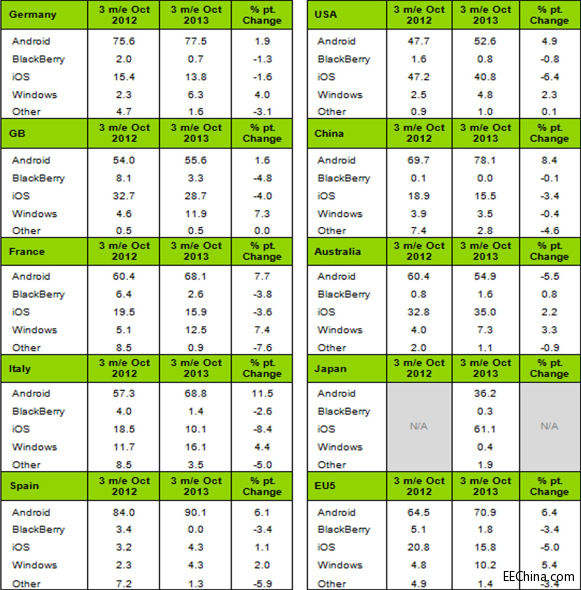
Below, Kantar's report on 10 selected smartphone markets for the three months that ended Oct. 31. The Sept. 20 release of the new iPhones gave Apple a "significant bounce," according to Kantar, but not enough to make a dent in Android's 70.9% share of sales in August, September and October.
The conspicuous exception was Japan, where Apple's share of sales hit 76.1% in October thanks to the company's new distribution deal with NTT DoCoMo.
Seeing Yang Leiguang, you might never imagine that the skinny boy traveled independently to Tibet for one month. More surprisingly, the 21-year-old from Henan University of Science and Technology brought only 500 yuan with him and earned other funds for travel on the way. He thinks that, with this trip, he accomplished his dream because he experienced some of the most memorable moments of his life.
Yang acquired his love for Tibet after watching a documentary about the holy place. “I remembered watching people kowtow in front of the Potala Palace. Their devoted faces and sincere emotions just touched me so much that I wanted to go there myself, ” he says. So he started to prepare for his long-awaited trip after he entered university and had more free time.
Though Yang had been preparing for the Tibet trip for three years –doing exercise, learning hiking and wilderness survival skills, practicing photography and reading travel guides –he still met some unexpected challenges on the way.
“Since it was my first time in Tibet, I underestimated the cost. I had to use every means to live cheaply and make more money, ” he says. In one month’s time, he did several different jobs. He got paid to mark down the names of the people who reserved tickets to enter the Potala Palace; he handed out leaflets; and what he felt most thrilled about was selling souvenirs.
“I learned from one of my fellow backpackers that he was making money from selling souvenirs, so I bought accessories from the open market and sold them in the city center just as he did, ” Yang explains. But that work was not risk-free. Like all the other vendors, Yang ran away whenever someone came to tell him to stop selling souvenirs.
For most of the trip, Yang handled situations properly, but there was one moment when he felt embarrassed and devastated.
尽管旅行中的大多数状况他都可以应对自如,但是有一次尴尬经历几乎令他崩溃。
“That was at Nam Co, ” he says. “A girl and I wanted to go back to Lhasa, but we couldn’t get a free ride until 3 or 4 o’clock in the afternoon when a pickup truck came and agreed to take us”. But there was only one seat available. Yang is a gentleman, so he gave his seat to the girl, but he left all of his stuff on board.
When he realized his mistake, it was already too late. He couldn’t catch up with the vehicle, and he didn’t have a cell phone to call the police or the girl. He had to walk alone along the road. “I walked for hours on the road, and I even worried about the worst result –that I may die of thirst or freeze to death, ” he says. He was lucky enough to eventually catch a bus to Lhasa, where he met the girl again and got his stuff.
The trip didn’t only bring Yang good memories and friends but also beautiful photos. He used these photos to make postcards and sell them on his campus. “I earned some money from this business, which will fund my next trip, ” Yang says.



网友评论